
New Construction Costs in New York (2026): What the Data Actually Shows
Using independent market data from Google, Angi, and RSMeans to compare real turnkey costs.

Homes by Covenant
Licensed • Insured • Code-Compliant
Construction Experts
A Transparent Look at New Home Costs in New York



New Construction Pricing Analysis — Upstate New York (2026)
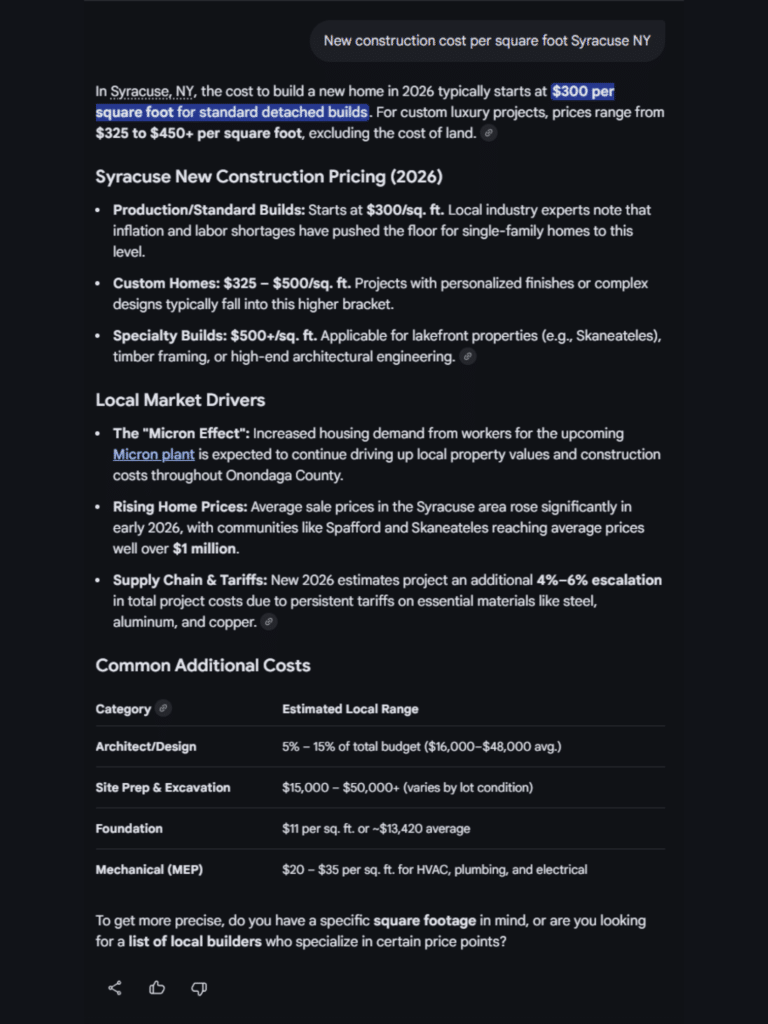
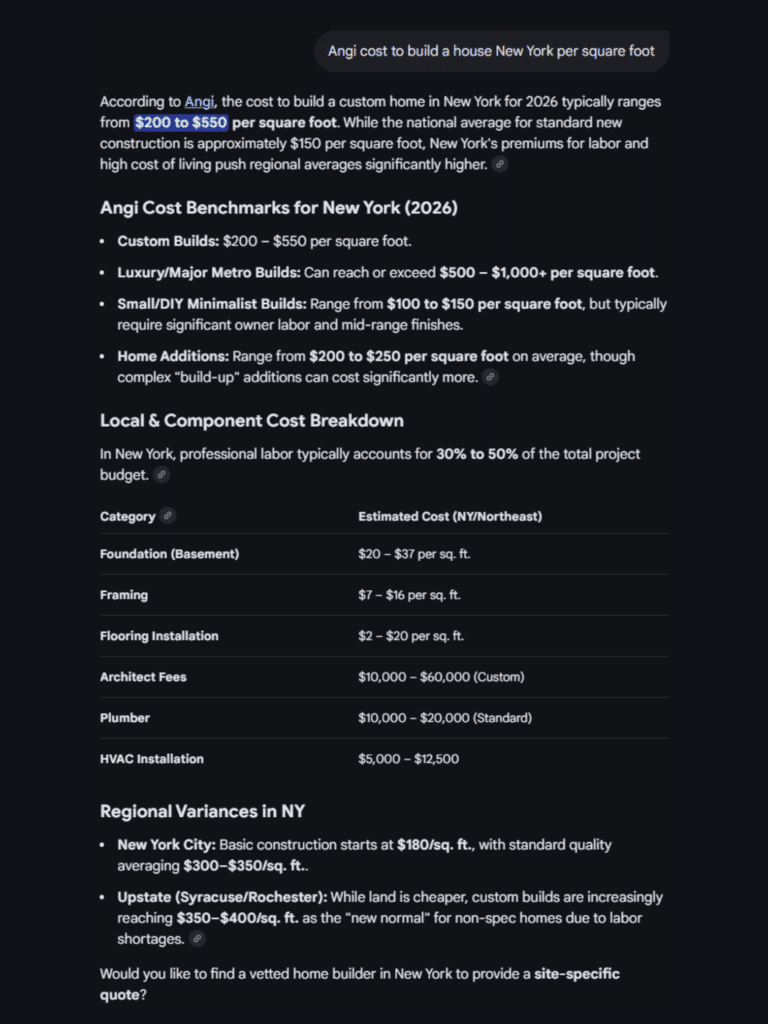
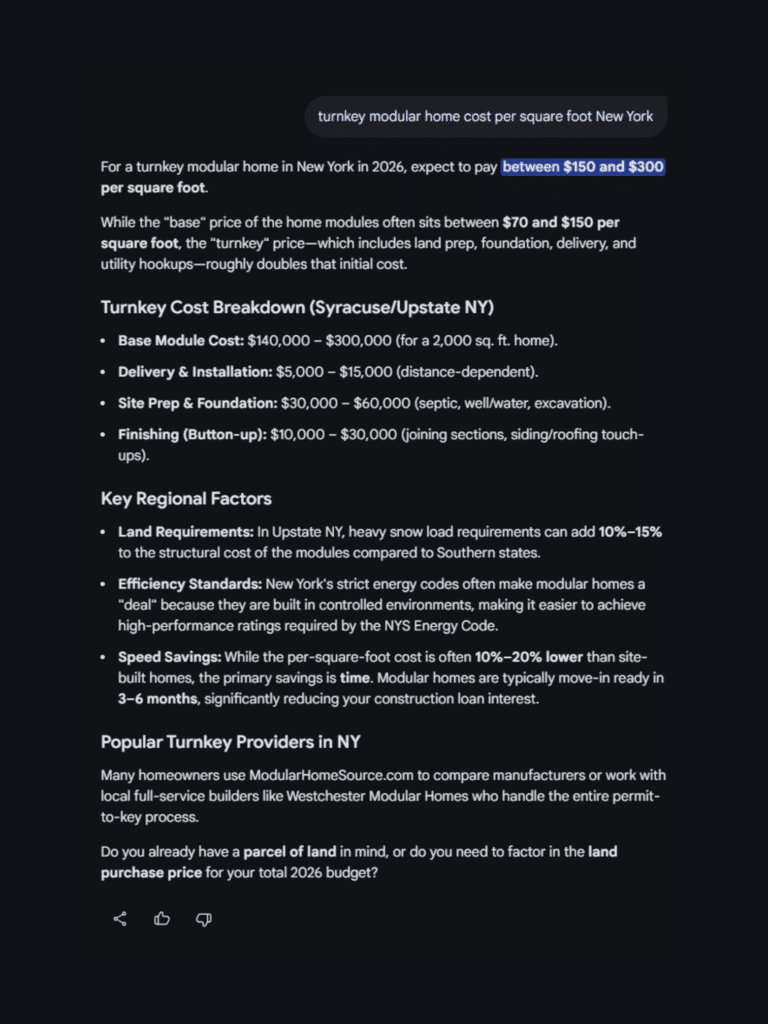
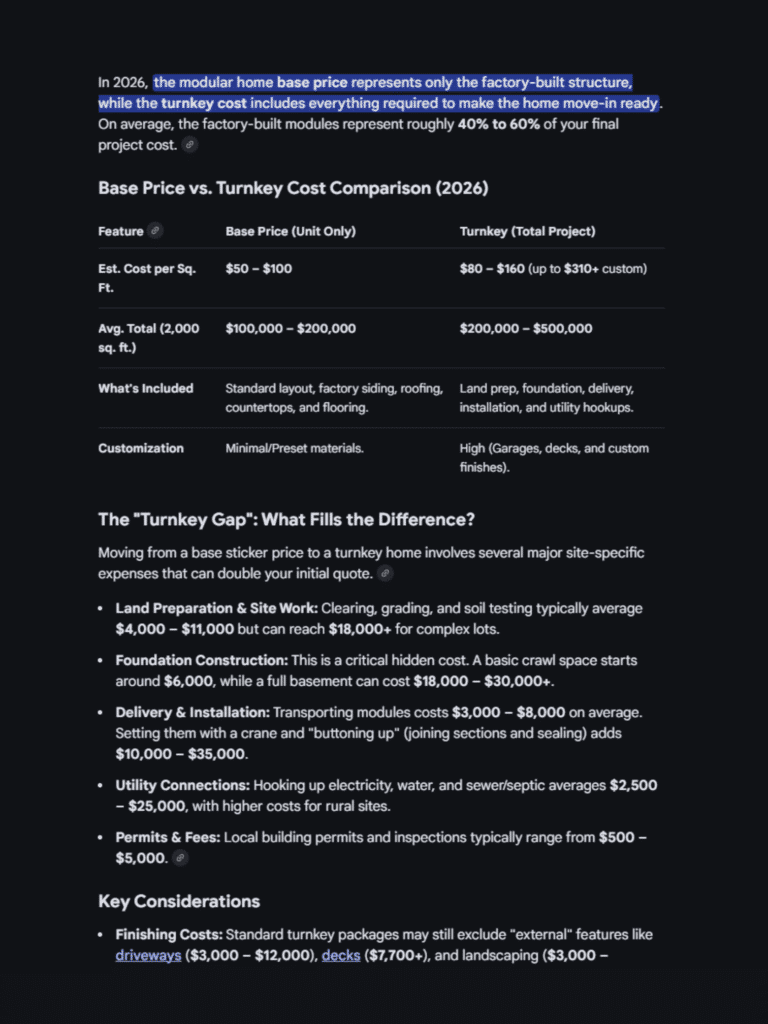
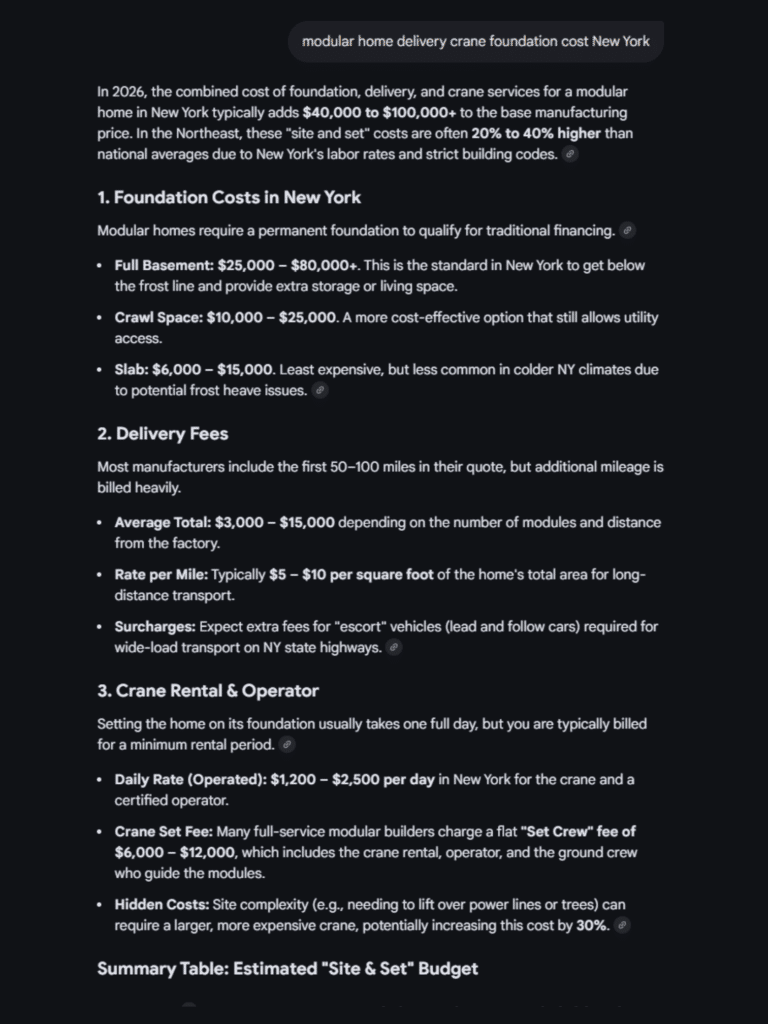
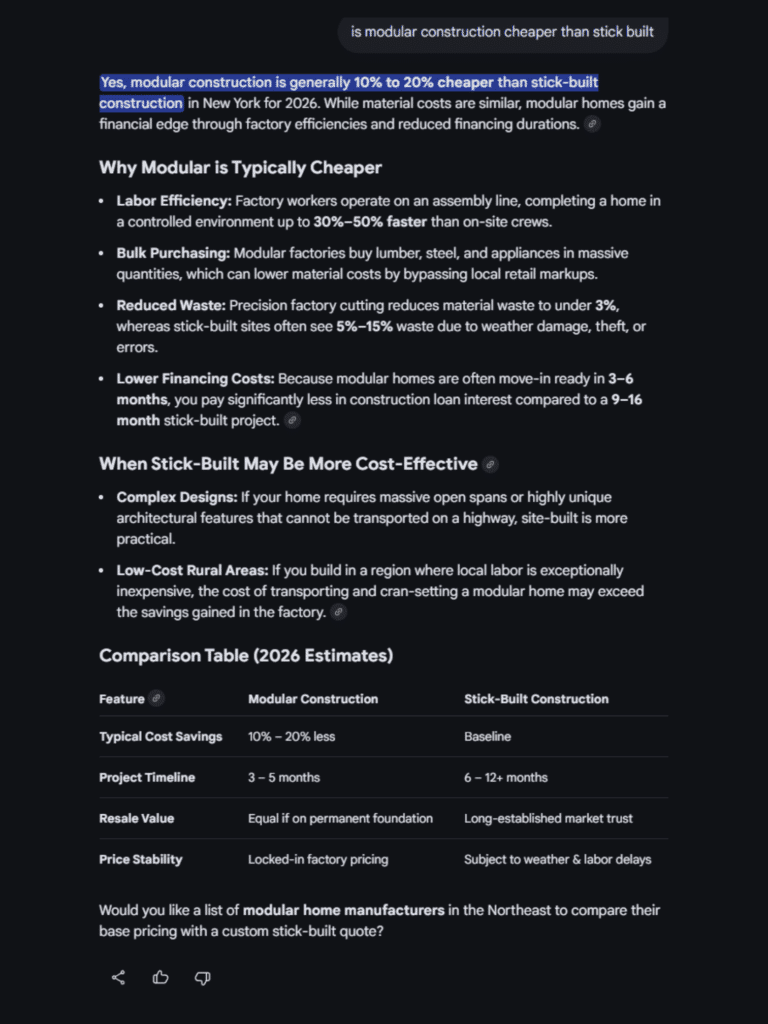
This analysis examines the real cost of building a home in Upstate New York in 2026, comparing stick-built construction and turnkey modular construction using independent, third-party market data. Sources include Google-indexed summaries from Angi, RSMeans, and regional New York contractor reporting. The goal is transparency: separating advertised pricing from real, move-in-ready costs and showing where Homes by Covenant™ sits within the documented market.
- Data Verified: Q1 2026
- Scope — Stick-Built vs Modular (Turnkey, Finished Homes)
- Market Window — 2025–2026 Pricing Conditions
- Builder Reference — Homes by Covenant™ / CDG
The Questions Buyers Should Ask
Before Comparing Prices
What does it really cost to build a home in New York in 2026?
Sticker prices vary wildly — but most exclude critical costs like site work, logistics, taxes, code compliance, and post-set completion. We separate advertising numbers from move-in reality.
Why do two homes with similar square footage have radically different prices?
Square footage alone doesn’t account for structure, labor intensity, energy codes, site conditions, or logistics. Price gaps usually come from what’s missing, not what’s added.
Are modular homes actually cheaper — or just advertised that way?
Many “low” modular prices stop at the factory door. Delivery, crane services, foundations, utilities, inspections, and finish labor are often billed later — or left to the homeowner to manage.
What does “turnkey” actually mean — and who decides?
There is no universal definition. Some builders call a house turnkey once it’s set on the foundation. We define turnkey as finished, inspected, and ready to live in.
How do Covenant prices compare to real market averages?
We don’t compare against marketing claims or outdated blog posts. We compare against current regional data, contractor-reported ranges, and third-party cost benchmarks.
Why do some builders look cheaper at first — then cost more later?
Fragmented pricing shifts risk onto the homeowner. Change orders, coordination gaps, and “not included” line items are where budgets quietly expand.
What’s included in a Covenant build that others bill separately?
Most builders price in fragments. We price the system: planning, logistics, compliance, coordination, and completion — not just materials.
How are site conditions handled — before they become surprises?
Access, crane radius, soil conditions, utilities, drainage, and inspections all affect cost. We account for these up front, not mid-build.
Does lower cost mean lower quality?
Only if corners are cut. Lower cost achieved through efficiency, planning, and reduced fragmentation preserves durability, safety, and long-term value.
How does this pricing hold up with banks, appraisers, and inspectors?
Fair market pricing isn’t about being cheapest — it’s about being defensible. Our numbers align with how projects are actually evaluated and financed.
What happens after the home is set?
Many problems don’t show up until after delivery. We account for finish work, tie-ins, inspections, and warranty responsibility — because that’s when quality is proven.
What are you actually paying for?
Not just a structure — but predictability, coordination, accountability, and fewer gaps between promise and reality.
The Market Reality
What the Data Actually Shows
1. New York Stick-Built Market (2026)
Independent sources consistently report:
Upstate NY stick-built homes:
$265–$325 per sq. ft.Syracuse & Central NY: Many builders now start near $300/sq. ft. for mid-range finishes.
These figures typically exclude land, major site work, and extended logistics.
2. Modular Homes — The Reality Behind the Ads
Advertised factory prices often show $50–$100 per sq. ft.
That is not move-in ready.
True turnkey modular costs in NY (2026):
Mid-range modular: $150–$250 per sq. ft.
High-end modular: $250–$400+ per sq. ft.
Added later by many builders:
Crane & set fees
Utility connections
Foundation coordination
Sales tax on modules
Finish labor & punch work
3. Where Covenant Lands
Homes by Covenant (turnkey, inclusive):
Typically below regional stick-built averages
At or below true modular turnkey pricing
Without removing scope
That means:
Lower cost per square foot
More included up front
Fewer “surprise” invoices later
4. What’s Included — That Often Isn’t Elsewhere
Covenant pricing integrates:
Site coordination & compliance
Crane logistics & set operations
Structural tie-ins & marriage-wall work
Energy-code alignment
Warranty systems
Documented inspections & QA
Most competitors price these after contract.
5. The Bottom Line
This isn’t underpricing.
It’s honest pricing.
Not cheaper by cutting corners
Cheaper by eliminating fragmentation
Cheaper by planning the whole system from day one
Fair market value — with fewer gaps.
Why Real Home Costs Must Include Site Work
And Why Homes By Covenant Still Comes Out Ahead
Why Homes By Covenant Costs Less — Even After Real Site Costs
When people compare home prices, they often compare the house itself and forget the part that actually blows budgets up: site work. In Central and Upstate New York, real site and utility work—including septic or sewer, utilities, excavation, foundation coordination, and grading—typically adds $100,000 to $120,000 to any new home. That applies to stick-built homes, modular homes, and custom builds alike. Those costs are unavoidable. What matters is what the total looks like after they’re included.
And even then, Homes By Covenant still comes out ahead.
How Homes By Covenant Compares in the Real Market
When we look at finished, move-in-ready homes (not factory-only pricing), the difference is clear—especially for the homes most families actually build.
For mid-size and larger homes (about 2,000 sq. ft. and up):
Homes By Covenant averages about 40% less per square foot than comparable stick-built homes in the region
Homes By Covenant averages about 25% less per square foot than other true turnkey modular builds
These comparisons reflect current 2025–2026 pricing conditions in Central and Upstate New York and include real site costs.
What That Looks Like in Real Dollars
This isn’t about shaving a few thousand dollars. The difference is substantial:
Around 2,000 sq. ft.
→ roughly $200,000 less than a comparable stick-built homeAround 2,500 sq. ft.
→ roughly $250,000 less than stick-built constructionAround 3,000 sq. ft.
→ often $275,000–$300,000 less than stick-built construction
These savings come from planning and integration, not from cutting corners.
How We Talk About the Numbers (On Purpose)
We keep the message simple and honest:
About 40% less than stick-built homes
About 25% less than other turnkey modular builds
Based on finished homes with real site costs included
We don’t rely on factory-only pricing, teaser numbers, or fine print.
Where Homes By Covenant Lands in the Market
Homes By Covenant turnkey modular builds typically land at approximately $195–$205 per square foot, all-inclusive.
That positioning places us:
$20–$50 per square foot lower than many true turnkey modular competitors
~$100 per square foot lower than the regional stick-built average
And we achieve this without removing scope. What That Means in Real Dollars is that is your money as a client.
Why the Price Is Lower (Without Lowering Quality)
Homes By Covenant doesn’t cost less because of cheaper materials or rushed labor. It costs less because the build is treated as one coordinated system, not a pile of disconnected line items.
That means:
Fewer handoffs
Fewer surprises
Fewer change orders
Less duplicated cost
Clear responsibility from start to finish
Most builders price pieces separately and sort it out later. We don’t.
A Quick Note on Smaller Homes
Smaller homes (generally under 1,200 sq. ft.) experience higher per-square-foot site costs no matter who builds them. That’s an industry reality, not a Homes By Covenant issue. The pricing advantage is strongest—and most meaningful—for the homes most families actually choose to build.
Showing the Proof — Without the Games
The math works because it’s transparent. Rather than publishing private client invoices, we use sample all-in pricing examples that show:
The model
The square footage
Typical site costs
The final cost per square foot
How it compares to the local market
That way, anyone can check the math without anyone’s privacy being compromised.
The Bottom Line
Homes By Covenant doesn’t win on price by doing less. It wins by building smarter. When real costs are included, the numbers speak for themselves—and that’s why this approach works.